


Nail fungus on the legs (Onychomycosis) is a disease that is caused by damage to mushrooms with skin plants (up to 96%), with less frequent mold and yeast-like (about 4%).Infections are most often spread from the skin of the feet, and mucus bacteria are present on the legs for a long time.Here, it finds favorable conditions for development - increasing humidity and nutrition.Under the influence of pathogens, the structure is disturbed and the color of the nail plate changes.As time goes by, their complete destruction occurs.
Thyroid disease is not only a cosmetic defect, but also a serious disease. Under the supervision of a dermatologist, it is subject to timely testing and appropriate treatment.
Fungi on legs are recorded among millions of people around the world.About 5% of the population suffers from myomycosis.The most extensive disease is common among people aged 50 to 60.At this age, every second person is sick.Due to the presence of somatopathology (mainly vascular and endocrine), it is difficult to treat pathology.Men are sicker than women.Older people get sick more frequently than younger people.Children suffer very little, mainly suffering from serious illnesses.Using AIDS, the disease has atypical conditions.
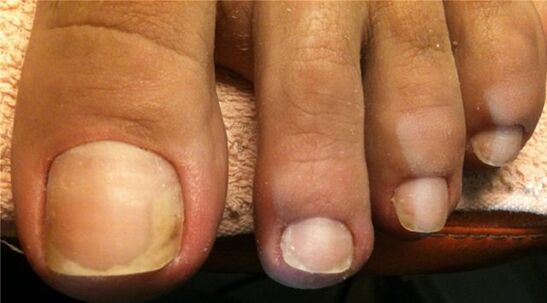
Causes of tumor disease
The causes of leg tumor disease are different types of mushrooms: skin plants, yeast-like or moldy respectively or combined.
- Skin plant mushrooms account for up to 90% of all dinoflagellosis.They are represented by mushrooms of the genus T. rubrum and T. mentagrophytesvar. Interdigitale.Most of the time, the nail plate on the legs is affected by the burr rub.Skin plants are common in countries with temperate climates.
- Candida yeast fungi are rarely caused by Candida on the legs.They account for about 3% of all formicrobial diseases.In addition to Candida albicans, mushrooms such as Streptococcus tropicalis, Streptococcus parasitococcus and guilliermondii can also cause the disease.
- Most molds cannot cause nail fungi by themselves.Their few species are independent pathogens - these are hyaluronic acid and Nattrassia mazziferee, which are not more pathogenic than skin plants.Myomemycosis on the legs is mold, such as scopulariopsis brevicaulis, aspergillus spp., pyrenochaeta unguis-Heominis, selternaria spp., fusarium spp.wait.Infection is most common in hot and humid climates - tropical and subtropical countries.
Disease Epidemiology
Most thyroid diseases are phage-like infections.They are sick and mainly spread infections.
Skin plant mushroom
The source of the reservoir and skin plant mushroom is a patient whose pathogen is transmitted through direct contact or his personal belongings.The infection almost always extends to the nails on the legs with the affected feet, a disease that takes place both clearly and secretly (deleted moldy forms).In the presence of disease among one of the family members, the risk of infection is repeatedly increased.
Mushrooms are spread through infected shoes, clothes, documents and tongs and are used in nails, carpets, linens, towels, towels, and more.The spread of infection occurs when the regular bathroom, shower, sauna, swimming pool, gym and beach, shower room, shower, sauna, public bathroom.It helps to bring mushrooms into the feet by walking barefoot in public areas.Pathogens live on wooden floors and floors for a long time.
Yeast - Mushroom
Candida yeast-like mushrooms are saprophytic flora that always live on one's skin.A good immune system is limited by the growth of pathogens.Long-term intake of antibiotics, birth control pills, glucocorticoids and cell inhibitors, endocrine pathology (usually diabetes), and many diseases, deplete the immune system.Explosive mushrooms can penetrate nails from the patient's skin and mucous membranes, or enter the body with carbohydrate-rich infectious products.
Mold
The mold lives in the soil.Their disputes belong to products, things and environmental objects.Nedimatophytes don't spread among people.

Risk factors for disease development
For mushrooms, skin plants are characterized by hereditary tendencies, males, age of old age, vascular disease, diabetes, diabetes, immunodeficiency status, increased sweating, nail damage, and the presence of other skin diseases.
Infections of Candida yeast-like mushrooms are characterized by increased temperature and humidity, immunodeficiency status, increased blood sugar, nail damage, and failure to comply with personal hygiene rules.
For mold infections, severe immunodeficiency status and nail damage are characteristic.
In danger
The risk groups regarding Onykhomycosis development include:
- People constantly use locker rooms, showers, saunas, etc.
- Professional athletes (swimmers, soccer players, athletes, etc.).
- Military personnel and others use proprietary shoes.
- Male face.
- Age over 60 years old.
Contributing to the development of fungi on the legs:
- Wear tight, tight shoes.
- Increase sweating or dry legs.
- Nail damage and abrasions, foot wear, nails that are facing inward, etc.
- Humid and hot climate accommodation.
- Walk barefoot in public places.
- The presence of skin diseases of nail keratinization (psoriasis, icariasis) is interrupted.
- Diabetes, immunodeficiency status, lower limb circulatory diseases, blood diseases, long-term intake of corticosteroids, antibiotics and cytostatic agents and other diseases.
- Genetic tendency.
Fleet fungi development path
There are several ways to put mushrooms into the nail:
- Distal or distal (from free or lateral edge).
- Surface (directly through the nail plate).
- Proximal end (subtyo -gut).
Distal distal path of mushroom penetration
The penetrating distal or distal land pathway is characterized by phospholipid mushrooms.Pathogens are introduced into the nail plate from the free edge (distal) or lateral area (lateral edge).The main inflammatory process occurs in the nail bed, where the enhancement occurs.The small air layer of the skin at the free edge thickens (hyperembryosis), so the nail plates are lifted and exfoliated (methyl dissolves).
In addition, the infection spreads in the direction of the hole and penetrates into the nail plate, gradually (slowly) destroyed.Due to damage to the matrix, total malnutrition tumor diseases occur.
Excessiveness of the nail bed was observed in chronic eczema, psoriasis, warts, red flat lichens.

Surface pathways for mushroom spread
Mushroom hair plant weed plant.Compared with other skin plants, the keratin structure of the nail plate is more aggressive than the keratin structure of the nail plate.They mainly affect the outside of the nail plate, resulting in the development of white surface myomycosis.Under the influence of cutinase, mushrooms use mycelium to perforate the layer, gradually capturing all layers of the nail plate.Mainly, 1 and 5 toes are affected.When walking, they are the biggest shoe trauma.In this disease, 1 and 44 interfolds are affected.
It is believed that the surface form of thyroid disease may also be caused by fungal-non-human plant plants: Acremonium spp., oxysporum fusarium oxysporum and certain types of Aspergillus.
Proximal mushroom distribution path
The third path for mushrooms to pass through the nail plate is through the proximal nail roller and nail bed.The failure begins with the skin in the nail roll area, which thickens and exfoliates the nail surface.In addition, the last part of the matrix and nail bed are involved in the process and damage to furrows, irregularities and cracks appear on the nails.As pathogens penetrate into the nail plate, the nails will obtain a white opaque color over time.Over time, notice complete damage and loss of nail plates.Infection is often found in patients with HIV who are vascularly transmitted.
Characteristics of damage to mushrooms from Candida yeast
The damage of Candida mushrooms begins with inflammation of the vertebrae-proximal (located near the hole).Its edema and thickening were noted, resulting in the separation of the cuticle from the surface of the plate.Furthermore, the mushrooms fall freely into the matrix and nail bed, resulting in finger tissue nails over time.
Characteristics of incorpoons for mushroom damage
The damage to the nails of mushrooms is secondary to non-heart plants.The mold (usually scytalidium spp.) is set between the already affected nails - cracks, spaces between scallops of the nail bed or desolate containers.Next, high venereal diseases and slow damage developed on the nail plate.
Clinical form of oncology on the legs
There are several forms of dinoflagea on the legs:
- Distant edge.
- White shallow.
- Proximity.
- Total malnutrition.
Distal distal leg subsea myomycosis
The form of this disease is the most common.In most cases, myomycosis is caused by skin bacteria, especially phospholipid rubrum.Pathogen penetrates the nail plate from the free edge and side edges.Perenophaeum hypermastitis occurs, so the nails are separated from the finger tissue (Onycholysisy), which loses transparency, acquires a white or yellow color, and begins to collapse.As the seabed high-compatibility disease progresses, the nail plates seem to have become thicker.As the disease progresses, the focal point of the lesion expands toward the pore, as indicated by the emerging yellow bars.Over time, the entire nail plate and matrix are involved in the pathological process, which over time can lead to malnutrition and destruction of the nails.
In older adults, significant hypervenous disease (thickening), positive hybridization (thickening and deformation in the form of poultry claws) or nematodes (concave deformation) are often observed.Their nails are often affected by mixed flora - skin plants, molds and even bacteria.
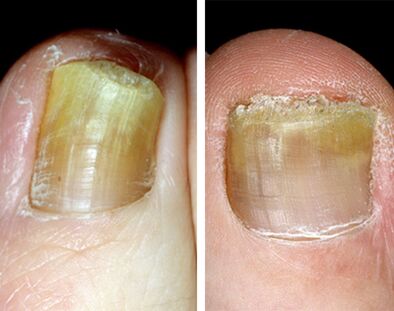
Form of tumor disease on the surface (white) legs
White surfaces on the legs are the second largest distribution of injuries.Its main reason is hairy plants weed plants.Trans-Digitale penetrates directly into the nail plate through its upper part (front of the rsal), as well as certain types of fungi-non-river plants.Most are affected by the first nail of the leg, with less frequency - fifth.
At first, small white dots and bands appear on their surface, eventually increasing the surface.Gradually, the color turns yellow, ocher.The surface of the nail becomes loose, rough, powdery, and easily jumps off.Thickening and separation from the nail bed did not occur.
Proximal subsea form of proximal myelopathy on the legs
This form of mycotic disease is rare.He accounts for about 3% of all myomycosis.The reason is Candida albicans and yeast-like mushrooms with hairy burrs.Nail candidiasis before inflammation of fence roller.It swells, gets red, becomes brilliant.Lifting the cuticle, the infection penetrates into the substrate and the last part of the nail bed, and when it is damaged by irregularities and cracks in the grooves, nail plates, the loss of natural light and clouds is noticed.Gradually, the nails are damaged and disappear in severe cases.This form of tumor disease on the legs is often found in patients with HIV infection.
Total malnutrition forms of tumors on the legs
This form of tumor disease often presents long-term flow (chronic course) diseases, and is more common in fungi of phospholipids and Candida albicans.Meanwhile, the nail plate, bed and matrix are involved in the pathological process.The reason for borrowing nails is the development of high tumor diseases in the seabed.Over time, the nail plates are destroyed and new plates due to the affected matrix do not grow or grow poorly.
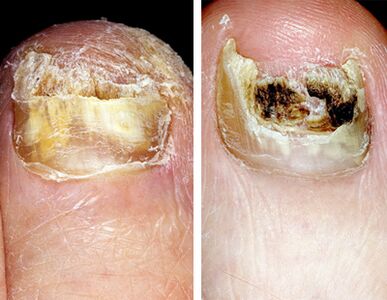
Types of damage to the nail plate
There are 3 options for dinoflagea:
- Normal.
- Thick.
- Shrink.
Normal nutritional aspergillosis on the legs
Using normal nutrition types, the infection is located on the upper layer of the nail plate.The thickness and color in its disease do not change, but spots and stripes can be seen deep in it.The color of the nails varies from white to saturated yellow.After a while, the spots and stripes merge.The damaged area spreads across the nail plate, excluding the moon.No rupture and fear were observed.Sometimes you will find a slight looseness of the free edge.With proper treatment, it can be cured.
The fat on the legs
This type of dinoflagea is the most common.Due to the development of high-sea venereal diseases, the nail plates are significantly thickened, deformed and lose their luster.The nails turn into imbalance, dullness, obtaining brown-gray colors and debris.The moon's area is not affected.The disease makes the patient feel tangible.In older patients, the development of thyroid hybridization is noted - nails thicken, prolong and bend like bird paws.
Types of atrophy on the legs
The nail plates of the atrophic type quickly lost their connection from the nail bed, and many voids appear in their layers, which fade, thin, and discolor to white or yellowish white.The surface remains smooth for a long time.As time goes by, partial damage occurs.
Signs and symptoms of nail fungus
In most cases, the change in nails begins with free (distal) or transverse edges.
Color changes.As thyroid disease changes, the color change of the nail plate is the first sign of the disease.It becomes opaque, often loses its luster, obtains a white or yellow color, and carries mold mushrooms - brown, brown, green, and even black.
Thickening.The development of high tumor diseases in the seabed leads to an increase in the number of keratinous masses, leading to thickening of nails.
Crush and destroy.If the disease is caused by the important activity of mushrooms, the nail plate collapses first, and over time, the nail plate is completely destroyed.
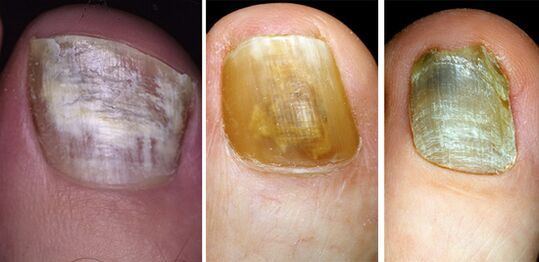
Characteristics of nail damage with different types of Onychomycisosis
Damage to nails with different types of fungal diseases has its own characteristics.The main types of pathogens are trichomonas glitches (70-90%) and hairy plant plant plant plant v. interdigitale (8-30%).Candida albicans, mold mushrooms, T.MentagrophytesV.Gypseum, T.Verrucosum, T.Tonsuras and T. violaceum, epidermal plants, hairy plants are less common.Schonleinii.
Muscular atrophy on the legs
Ruphytics in the Russian Federation account for 70% to 90% of all mycoses.The feet in the disease are most commonly affected (usually scaly dry type).The burrless satellites of the feet are nail fungi on the legs.With mycomycosis, the distal di-fiber form of spondylosis is often present, with obvious high-breast degeneration characterized by several fingers on the legs immediately affected and often on one side of the finger.The disease has no special subjective feeling.When wearing shoes, the pain and discomfort develop obvious high companion diseases, hybridization and nail-to-inward nails.The root cause of the infection is usually in the patient's family.
Typically, relevant porridges are recorded: rubrum and Candida albicans, phospholipid rubrum and molds of hairy plants.Evaluation of cultural research is important.
Myomycosis on the legs.Mentagrophytes mushrooms.V.Interdigitale
Mushroom T. Mentagrophytes.V. Interdigitale affects the skin of the feet and nails.Epidermal plant disease accounts for 10% to 30% of all mycotic diseases.
Due to the disease, the upper (dosal) part of the nail plate is affected.White forms usually appear in shallow white form.The pathological processes mainly involve 1 and 5 toes (they suffer the greatest trauma of the shoe during walking) and 1 and 4 folded folds.When using a regular bathroom, the spread of infection occurs in showers, saunas, pools, beaches and pools.
Dinoflages on the legs damage the mushrooms of Candida yeast
This form of mycotic disease on the legs is rare.It accounts for 3% of all cancers.This disease is often documented in people with chronic generalized candidiasis.Usually, nail damage begins with inflammation of the fence roller located near the hole.Its edema and thickening were noted, resulting in the separation of the cuticle from the surface of the plate.Furthermore, mushrooms can fall freely into the matrix and nail bed (proximal subface form), and if grooves, irregularities and cracks appear on the nails, natural radiance and clouds appear, they will appear brownish brown.Gradually, the nails are damaged and disappear in severe cases.

Myomycosis on both legs caused by mold
Plastic mushrooms are scattered in already affected nail cracks, entering the space between nail beds or desolate boat scallops.Next, high venereal disease occurs and slowly destroys the nail plate, during which the black stain (scytalidium spp.) or green or gray (Scopulariopsis brevicaulis) color.
Diagnosing thyroid disease
Onychomycisois' diagnosis is based on data from epidemiological history, clinical status of the disease, and laboratory research method data.
In microscopic examination of the material, the properties of the disease (mushrooms or other pathogens) are established.The identification of mushrooms was established by microbial examination (material crops on nutrient medium), followed by microscopy of pure culture.The process was laborious and was successful in half the case.Correct collection of materials from affected nails is key to successful microbial research.
Differential diagnosis
Only half of patients with dermatologists with changes in nail shape and color can cause fungal disease.Distinguish tumor diseases from eczema, psoriasis, regeneration syndrome, pachionichia, daria disease, flat lichen, Norwegian scum, bacterial lesions.